
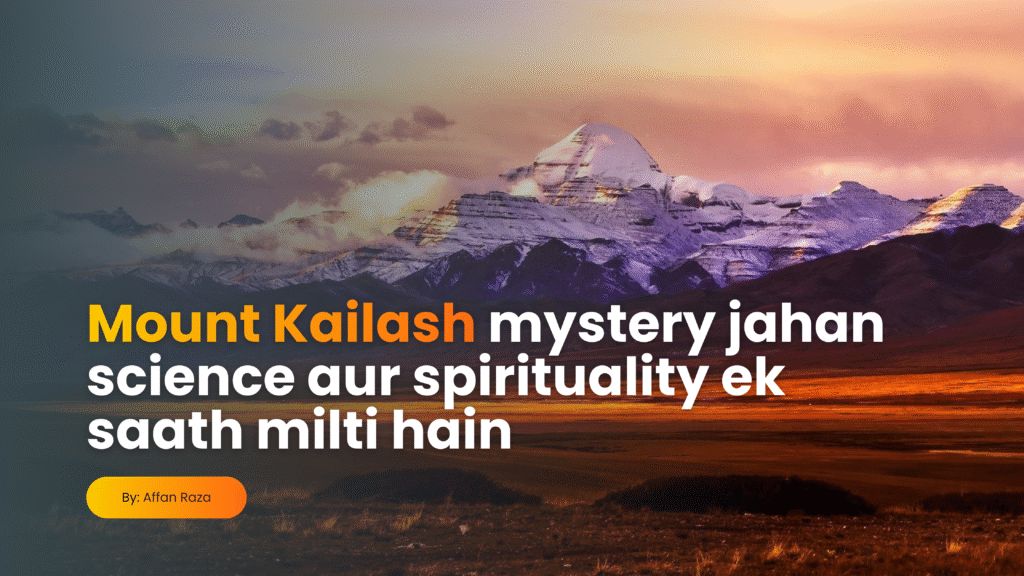

Mount Kailash is not just a mountain—it is a phenomenon that stands at the crossroads of geography, spirituality, religion, and mystery. Rising majestically in the remote Tibetan Plateau, Mount Kailash has fascinated explorers, devotees, scientists, and travelers for centuries. Yet, despite being lower than many of the world’s highest peaks, no one has ever officially climbed Mount Kailash.
Why is that so? Is it because of religious beliefs, natural challenges, unexplained phenomena, or something far deeper? In this detailed and systematic blog, we will uncover all the major reasons why no one can climb Mount Kailash, separating facts from myths while respecting faith and science alike.
1. Introduction to Mount Kailash
Mount Kailash stands at an elevation of 6,638 meters (21,778 feet) and is located in the Ngari Prefecture of Tibet, near the borders of India and Nepal. It forms part of the Trans-Himalayan range and is the source of four major rivers:
- Indus
- Sutlej
- Brahmaputra
- Karnali (a tributary of the Ganges)
Geographically alone, this makes Mount Kailash extremely significant. But its importance goes far beyond physical geography.
2. A Mountain Sacred to Four Major Religions
One of the strongest reasons Mount Kailash remains unclimbed is its unmatched spiritual significance.
2.1 Hinduism
In Hindu belief, Mount Kailash is the abode of Lord Shiva, where he resides with Goddess Parvati in eternal meditation. Climbing the mountain is considered a grave sin, as it would be like invading the personal space of the divine.
2.2 Buddhism
For Buddhists, Mount Kailash is known as Mount Meru, the center of the universe. It is associated with Demchok (Chakrasamvara), a deity representing supreme bliss.
2.3 Jainism
Jains believe that their first Tirthankara, Rishabhdev, attained liberation (moksha) at Mount Kailash.
2.4 Bon Religion
Bon, the ancient indigenous religion of Tibet, considers Kailash a spiritual axis of the world, where heavenly powers reside.
Because it is sacred to multiple faiths, no government or authority has ever granted permission to climb it.
3. The Official Ban on Climbing Mount Kailash
Unlike Mount Everest or other Himalayan peaks, Mount Kailash is legally and culturally protected.
- The Chinese government, which administers the region, has never issued a climbing permit.
- International mountaineering organizations respect the ban.
- Religious communities worldwide strongly oppose any attempt to scale the peak.
This makes Mount Kailash one of the few major mountains in the world that remains completely untouched by human climbing activity.
4. Failed Attempts and Strange Incidents
Although officially no one has climbed Mount Kailash, there have been attempts—and they ended in mysterious ways.
4.1 The 2001 Spanish Expedition
A Spanish climbing team reportedly received preliminary permission to climb Mount Kailash. However, before they could proceed, massive protests erupted across India, Nepal, and Tibet. Under immense pressure, the permission was revoked.
Interestingly, members of the team later claimed they experienced:
- Sudden illness
- Extreme mental disorientation
- Fear and anxiety without clear reason
They eventually abandoned the plan voluntarily.
4.2 The Russian Scientist’s Claim
Russian researchers once suggested that Mount Kailash is a giant natural pyramid emitting powerful energy fields. They believed the mountain could affect human biology, potentially accelerating aging and causing physical harm.
While these claims remain controversial, they add to the mountain’s aura of mystery.
5. Unusual Physical Structure of Mount Kailash
Unlike most mountains, Mount Kailash has a perfectly symmetrical pyramid-like shape.
- Its faces align closely with the cardinal directions.
- The mountain appears carved rather than eroded.
- Satellite images reveal strange geometric patterns around the region.
Many believe this structure is not entirely natural, although geologists argue it is the result of rare tectonic formations and erosion patterns.
Still, its shape is so unique that it fuels speculation about:
- Ancient advanced civilizations
- Lost technologies
- Cosmic or extraterrestrial influence
6. The Time and Aging Mystery
One of the most fascinating legends associated with Mount Kailash is the time distortion phenomenon.
Pilgrims and travelers have reported:
- Hair and nails growing unusually fast
- Feeling weeks older after just a few days
- Time perception becoming distorted
Some even claim that time moves faster near Mount Kailash, though science has not confirmed this. However, the region’s high magnetic activity and extreme altitude could influence human perception and physiology.
7. Extreme Natural Conditions
Even from a purely physical standpoint, Mount Kailash is extremely difficult to climb.
7.1 Harsh Weather
- Sudden snowstorms
- Sub-zero temperatures
- High-speed icy winds
7.2 Difficult Terrain
- Steep vertical rock faces
- Unstable ice and scree
- Lack of viable climbing routes
7.3 Thin Oxygen Levels
Although not as tall as Everest, Kailash’s location and atmospheric conditions make oxygen levels unexpectedly challenging.
These factors alone could deter even the most experienced climbers.
8. The Spiritual Alternative: Circumambulation (Parikrama)
Instead of climbing Mount Kailash, pilgrims perform a 52-kilometer circumambulation, known as Kailash Parikrama.
- Hindus and Buddhists walk clockwise
- Bon followers walk anti-clockwise
- Completing one parikrama is said to cleanse sins
- 108 parikramas are believed to lead to enlightenment
This ritual reinforces the belief that Mount Kailash is not meant to be conquered but revered.
9. Science vs Faith: A Delicate Balance
Science explains Mount Kailash as:
- A tectonic uplift
- Shaped by glacial erosion
- Located in a high-energy geological zone
Faith, however, views it as:
- The center of the universe
- A divine residence
- A spiritual gateway
What makes Mount Kailash unique is that science has not been able to fully dismiss the mysteries, and faith has not felt the need to prove them.
10. Why Mount Kailash Should Never Be Climbed
The question is no longer “Why can no one climb Mount Kailash?”
The real question is “Why should anyone try?”
Reasons it remains unclimbed:
- Deep religious sanctity
- Legal and governmental protection
- Respect for global spiritual sentiment
- Harsh and dangerous natural conditions
- Unexplained phenomena and mysteries
Mount Kailash stands as a rare symbol of human restraint, where reverence has triumphed over conquest.
11. Conclusion: A Mountain Beyond Human Limits
In a world where humans strive to conquer everything—land, sea, space—Mount Kailash remains unconquered, not because it cannot be climbed physically, but because it should not be climbed spiritually.
It teaches us an important lesson:
Not everything sacred needs to be scaled. Some places are meant to be respected, not reached.
Mount Kailash is not just a mountain.
It is belief, mystery, science, and silence—standing together in stone.
Mount Kailash ke bare me ache se janne ke liye ye video zaroor dekhien: